

Objectives and advantages of departmental accounts are an important topic for every B.Com student. Departmental accounts are kept by businesses that have several departments working under one roof. Walk into any large shopping mall or supermarket and you will see separate sections for garments, groceries, toys, footwear, kitchenware and electronics.
Each of these sections works almost like a small shop of its own. It has its own goods, its own customers, its own staff and its own sales. For more solved B.Com questions, visit GNDU Papers.
Question: Give the meaning of Departmental Accounting. Explain the objectives and advantages of Departmental Accounts.
Departmental Accounts
The owner of a multi-department business is naturally curious to know which section is doing well and which one is not. The total profit of the business does not answer this question.
To find the result of each section separately, the business keeps departmental accounts. In this answer, we will understand the meaning of departmental accounts and discuss the objectives and advantages of departmental accounts in simple language.
Meaning of Departmental Accounts
Departmental accounts are the accounts prepared separately for each department of a business, so that the profit or loss earned by every department can be known. The system of keeping such accounts is called departmental accounting.
In simple words, when a business is divided into different sections and the trading results of each section are worked out separately, those accounts are called departmental accounts.
All the departments are owned by the same person or firm and run under one common management. But for accounting purposes, each department is treated as an independent unit. Its purchases, sales, opening and closing stock, direct expenses and incomes are all recorded separately.
Common expenses that benefit all departments, such as rent, lighting, insurance and the manager’s salary, are shared among the departments on a suitable basis. For example, rent is usually divided according to floor area, and advertising according to sales. You can read the full list in our post on bases of allocation of joint expenses.
At the end of the year, a Departmental Trading and Profit and Loss Account is prepared in columnar form. Each department has its own column, so its gross profit and net profit can be seen at a glance and compared with the others.
Example: A departmental store has three departments: Ladies’ Wear, Men’s Wear and Toys. The total net profit of the store is ₹4,00,000.
When departmental accounts are prepared, they show that Ladies’ Wear earned ₹2,50,000, Men’s Wear earned ₹1,80,000, and Toys suffered a loss of ₹30,000. Without departmental accounts, the owner would never have noticed the loss in the Toys department.
Methods of Keeping Departmental Accounts
Departmental accounts can be kept in two main ways.
- Separate set of books for each department: Every department keeps its own complete books of account. This gives very detailed information, but it involves heavy work and cost. It is used only by very large businesses.
- Columnar books: The business keeps one common set of books, but with a separate column for each department in the purchase book, sales book, returns books and cash book. This method is simple and economical, so most businesses prefer it.
Objectives of Departmental Accounts
Departmental accounts are kept with several aims in mind. The main objectives are explained below.
1. To Find the Result of Each Department
The first aim of departmental accounts is to work out the gross profit and net profit, or loss, of every department separately. This tells the owner exactly how much each section is contributing to the business.
2. To Compare One Department with Another
When the results of all departments are placed side by side, the owner can easily compare them. The comparison shows which departments are strong and which ones are lagging behind.
3. To Compare Present Performance with Past Performance
Departmental accounts also help compare the results of a department this year with its results in earlier years. This shows whether the department is improving, standing still or declining.
4. To Help Management Take Sound Decisions
With clear departmental results in hand, the management can decide whether to expand a profitable department, improve a weak one, or close a department that keeps making losses.
5. To Control Expenses
Since expenses are recorded department-wise, any unnecessary spending in a particular department becomes visible. The management can then take steps to cut waste.
6. To Reward Departmental Managers Fairly
Many businesses pay their departmental managers a commission or bonus based on the profit of their department. Departmental accounts make it possible to calculate this reward correctly.
7. To Fix Responsibility
When each department’s results are known, the manager in charge can be held responsible for them. This makes managers more careful and accountable.
8. To Plan for the Future
Departmental results guide the management in planning future purchases, pricing, staffing and advertising for each department.
Advantages of Departmental Accounts
Keeping departmental accounts brings many benefits to a business. The main advantages are as follows.
1. Clear Picture of Each Department
Departmental accounts show the true position of every department. A loss-making department can no longer hide behind the profits of a successful one.
2. Easy Comparison and Evaluation
The performance of all departments can be compared easily, both with each other and with their own past results. This helps in judging the efficiency of each section.
3. Better Control over the Business
The management gets detailed information about the purchases, sales, stock and expenses of every department, which leads to tighter control over the whole business.
4. Sound Basis for Expansion or Closure
If a department earns good profits, it can be given more space, staff and goods. If a department shows continuous losses, its causes can be studied, and if it cannot be improved, it can be closed.
5. Fair Remuneration and Motivation
Departmental managers can be paid a commission linked to the actual profit of their own department. This is fair to them and also motivates them to work harder.
6. Healthy Competition among Departments
When results are known for every department, each department tries to perform better than the others. This healthy competition raises the efficiency of the whole business.
7. Proper Stock Management
Separate stock records show which goods move quickly and which ones remain unsold for a long time. This helps avoid both overstocking and shortage of goods.
8. Help in Fixing Selling Prices
Knowing the cost and profit of each department helps the owner fix suitable selling prices for the goods of that department.
9. Detection of Losses and Wastage
Since every department’s figures are watched separately, any theft, wastage or leakage in a department can be found quickly and corrected.
10. Useful Information for Budgeting
Departmental accounts provide reliable figures for preparing budgets and setting targets for each department in the coming year.
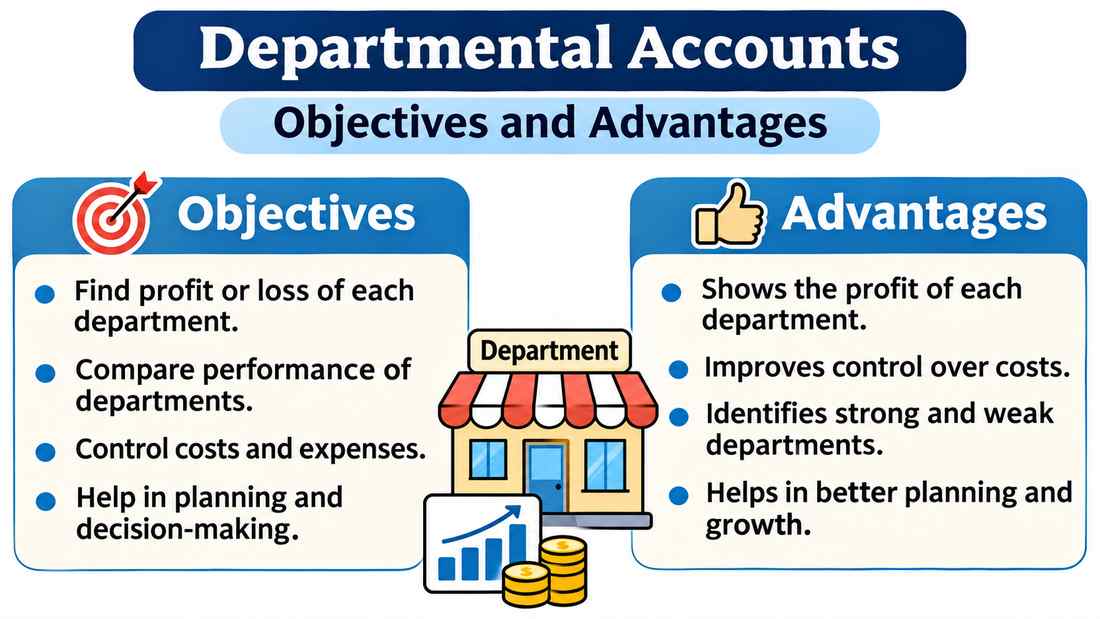
Objectives and Advantages of Departmental Accounts at a Glance
The objectives and advantages of departmental accounts are closely linked. The objectives tell us why a business keeps these accounts, while the advantages show the benefits it actually gets from them.
- Main objectives: Finding each department’s result, comparing performance, controlling costs, rewarding managers, fixing responsibility and planning ahead.
- Main advantages: Clear picture of each department, better control, fair remuneration, healthy competition, proper stock management and useful budgeting data.
Limitations of Departmental Accounts
Departmental accounts are very useful, but they also have some limitations. They increase the volume of accounting work and the cost of maintaining records.
Dividing common expenses among departments is not always easy, and if the basis chosen is unfair, the results can be misleading. Sometimes, too much rivalry between departments may also reduce cooperation.
These problems can be reduced by choosing fair bases for sharing expenses and by encouraging teamwork among departments. Accounting standards and good practices in India are guided by the Institute of Chartered Accountants of India (ICAI).
Conclusion on Objectives and Advantages of Departmental Accounts
To conclude, departmental accounts are accounts prepared separately for each department of a business, so that the profit or loss of every department can be found and compared.
The objectives and advantages of departmental accounts show why they are so useful. Their main objectives are to know the result of each department, compare performance, control costs, reward managers fairly, fix responsibility and support sound decision-making.
Their advantages include a clear picture of every department, better control, fair remuneration, healthy competition, proper stock management and useful information for future planning.
For any business with several departments, departmental accounts act like a mirror that reflects the true performance of every section. That is why they are considered an essential tool for large stores and multi-department businesses. For more important questions and previous year papers of B.Com, check the GNDU Papers homepage.