

What is planning? What is the difference between planning and plan? Describe the planning process.
Maslow and Herzberg theory is one of the most important topics concerned with management and organisational behaviour. Every manager wants employees who work with energy, interest and commitment. But what actually makes a person want to work harder? Is it money, job security, praise, or the chance to grow?
Psychologists and management thinkers have tried to answer this question through theories of motivation. For more solved B.Com questions, visit GNDU Papers.
Question: Compare and contrast Maslow’s Hierarchy of Needs Theory and Herzberg’s Two-Factor Theory of Motivation.
Among the best-known theories are Abraham Maslow’s Hierarchy of Needs Theory and Frederick Herzberg’s Two-Factor Theory. Both try to explain what drives human behaviour at work, and both are based on the idea that people act to satisfy their needs.
However, they look at motivation from different angles. In this answer, we will first understand each theory, and then compare and contrast them.
Maslow’s Hierarchy of Needs Theory
Abraham Maslow, an American psychologist, presented this theory in 1943 in his paper “A Theory of Human Motivation.” He believed that human beings have many needs, and these needs can be arranged in a hierarchy, or order of importance, like the steps of a ladder or the levels of a pyramid.
Maslow believed that a person starts by fulfilling the most basic needs first. Once these are fairly satisfied, they no longer motivate, and the person moves up to the next level of needs. In other words, a satisfied need is not a motivator. You can read more about Maslow’s hierarchy of needs on Wikipedia.
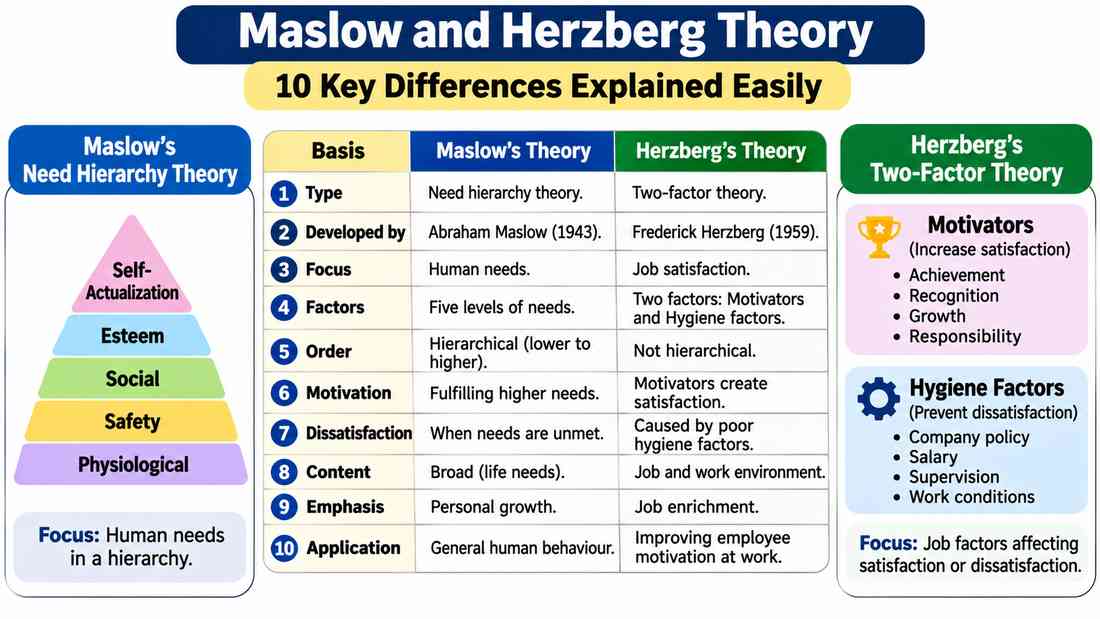
The five levels of needs in Maslow’s hierarchy are:
1. Physiological Needs
These needs are essential for staying alive, like food, water, clothing, shelter and rest. At work, these are met through a basic salary that allows a person to meet daily expenses.
2. Safety Needs
Once basic needs are met, a person wants protection from danger and security for the future. At work, this includes job security, a safe working environment, pension, insurance and medical benefits.
3. Social Needs
These needs relate to love, friendship, a sense of belonging and being accepted by others. At work, people want good relations with colleagues, teamwork and a friendly atmosphere.
4. Esteem Needs
These include self-respect, recognition, status and appreciation from others. At work, they are met through praise, promotions, job titles and rewards.
5. Self-Actualisation Needs
This is the highest level. It is the wish to reach one’s highest potential and develop fully as a person. At work, it is met through challenging tasks, creativity and opportunities for personal growth.
Maslow called the first four levels deficiency needs, because a person feels uneasy when they are not met. He called self-actualisation a growth need, because it is about personal development rather than filling a gap.
Herzberg’s Two-Factor Theory
Frederick Herzberg, an American psychologist, developed his theory in the late 1950s. Along with his colleagues, he studied about 200 engineers and accountants and asked them to describe times when they felt especially good or especially bad about their jobs. The results were published in 1959 in the book “The Motivation to Work.”
Herzberg found that the factors that made people satisfied with their jobs were quite different from the factors that made them dissatisfied. On this basis, he divided work-related factors into two groups.
That is why the theory is called the Two-Factor Theory, or the Motivation-Hygiene Theory. More details are available in this overview of Herzberg’s two-factor theory.
1. Hygiene Factors (Maintenance Factors)
Employees are not motivated by these factors, yet they feel unhappy when these factors are lacking. They are related to the job environment, not the job itself. They include:
- Company policy and administration
- Supervision
- Salary
- Relations with supervisors and colleagues
- Working conditions
- Job security
- Status
Herzberg compared them to hygiene in health. Good hygiene does not make a person healthy, but poor hygiene can make a person sick. In the same way, good hygiene factors only prevent dissatisfaction.
2. Motivators (Satisfiers)
These factors create real job satisfaction and encourage people to perform better. They are related to the content of the job itself. They include:
- Achievement
- Recognition
- The work itself
- Responsibility
- Advancement
- Growth
An important idea in Herzberg’s theory is that the opposite of satisfaction is not dissatisfaction but “no satisfaction.” Similarly, the opposite of dissatisfaction is “no dissatisfaction.” So removing dissatisfaction does not automatically make people motivated.
Similarities Between Maslow and Herzberg Theory
Although the two theories differ in many ways, they also have a lot in common.
1. Both Are Content Theories
Both theories focus on what motivates people, that is, the needs or factors that drive behaviour. They do not explain the process of how motivation happens.
2. Both Are Based on Needs
Both believe that people work to satisfy certain needs, and that unmet needs drive behaviour.
3. Hygiene Factors Match Lower-Level Needs
Herzberg’s hygiene factors, such as salary, job security and working conditions, are very similar to Maslow’s physiological, safety and social needs.
4. Motivators Match Higher-Level Needs
Herzberg’s motivators, such as recognition, achievement and growth, closely match Maslow’s esteem and self-actualisation needs.
5. Money Is Not the Only Motivator
Both theories suggest that money alone cannot keep people motivated for long. Once basic needs are met, higher needs such as respect and growth become more important.
6. Both Help Managers
Both theories guide managers to understand employees better and design suitable rewards and working conditions.
Differences Between Maslow and Herzberg Theory
The main differences between Maslow’s Hierarchy of Needs and Herzberg’s Two-Factor Theory are explained below.
1. Basic Idea
Maslow: Human needs are arranged in a hierarchy of five levels, and people satisfy them one by one, from the lowest to the highest.
Herzberg: Job factors are divided into two groups: hygiene factors that prevent dissatisfaction, and motivators that create satisfaction.
2. Nature of the Theory
Maslow: It is a broad theory of human motivation that covers every part of life.
Herzberg: It is a theory of work motivation that focuses mainly on the job and the workplace.
3. Basis of the Theory
Maslow: It is based mainly on Maslow’s observations and clinical experience, not on a formal survey.
Herzberg: It is based on an actual research study of engineers and accountants.
4. Structure
Maslow: It has five levels arranged in a fixed order.
Herzberg: It has two separate sets of factors, with no fixed order between them.
5. Role of Lower-Level Needs
Maslow: Lower-level needs can motivate a person until they are satisfied. For example, a hungry person is motivated by food.
Herzberg: Hygiene factors, which are similar to lower-level needs, do not motivate at all. They only prevent dissatisfaction.
6. Role of Money
Maslow: Money can be a motivator, especially for people whose basic needs are not yet met.
Herzberg: Money, or salary, is a hygiene factor. Its absence causes dissatisfaction, but its presence does not truly motivate.
7. Satisfaction and Dissatisfaction
Maslow: Satisfaction and dissatisfaction are seen as two ends of one line.
Herzberg: Satisfaction and dissatisfaction are two separate things, caused by different factors.
8. Order of Needs
Maslow: Needs follow a strict order. A higher need appears only after a lower need is satisfied.
Herzberg: There is no such order. Hygiene factors and motivators can work at the same time.
9. Focus
Maslow: It focuses on the person and their inner needs.
Herzberg: It focuses on the job, its content and its environment.
10. Applicability
Maslow: It is more useful for understanding people at all income levels, including workers in developing countries whose basic needs may not be fully met.
Herzberg: It applies better to professional and white-collar employees whose basic needs are already reasonably met.
How Maslow and Herzberg Theory Fit Together
Many management books show the two theories side by side. Maslow’s lower needs (physiological, safety and social) are placed next to Herzberg’s hygiene factors. Maslow’s higher needs (esteem and self-actualisation) are placed next to Herzberg’s motivators.
This shows that the two theories are not really opposite. Herzberg’s theory can be seen as an extension of Maslow’s ideas to the workplace.
While Maslow tells us what people need in life, Herzberg tells managers which of these needs will actually make employees work harder and which will only keep them from being unhappy.
Criticism of Maslow and Herzberg Theory
Maslow’s theory has been criticised because people do not always satisfy needs in a fixed order. An artist, for example, may chase self-actualisation even while struggling to pay rent. The theory is also hard to test scientifically.
Herzberg’s theory has been criticised for its research method. People tend to give credit to themselves for good experiences and blame others or the environment for bad ones, which may have affected the results.
Critics also point out that money can be a strong motivator for many workers, especially in lower-paid jobs.
Importance for Managers
Both theories offer useful lessons for managers.
From Maslow, managers learn that they must first take care of employees’ basic needs, such as fair pay, safety and job security, before expecting them to respond to higher rewards.
From Herzberg, managers learn that good pay and working conditions alone will not create motivation. To truly motivate employees, the job itself must be made interesting through responsibility, recognition, achievement and chances to grow. This idea led to the practice of job enrichment.
Conclusion on Maslow and Herzberg Theory
To conclude, Maslow’s Hierarchy of Needs Theory and Herzberg’s Two-Factor Theory are two of the most important content theories of motivation. Both agree that people are driven by needs and that higher needs like recognition and growth matter more once basic needs are met.
However, they differ in their structure, basis and focus. Maslow presents a five-level hierarchy of human needs that applies to life in general. Herzberg divides work factors into hygiene factors and motivators and focuses specifically on the job.
Maslow treats lower needs as motivators until they are satisfied, while Herzberg says hygiene factors only prevent dissatisfaction. For more important questions and previous year papers of B.Com, check the GNDU Papers homepage.