

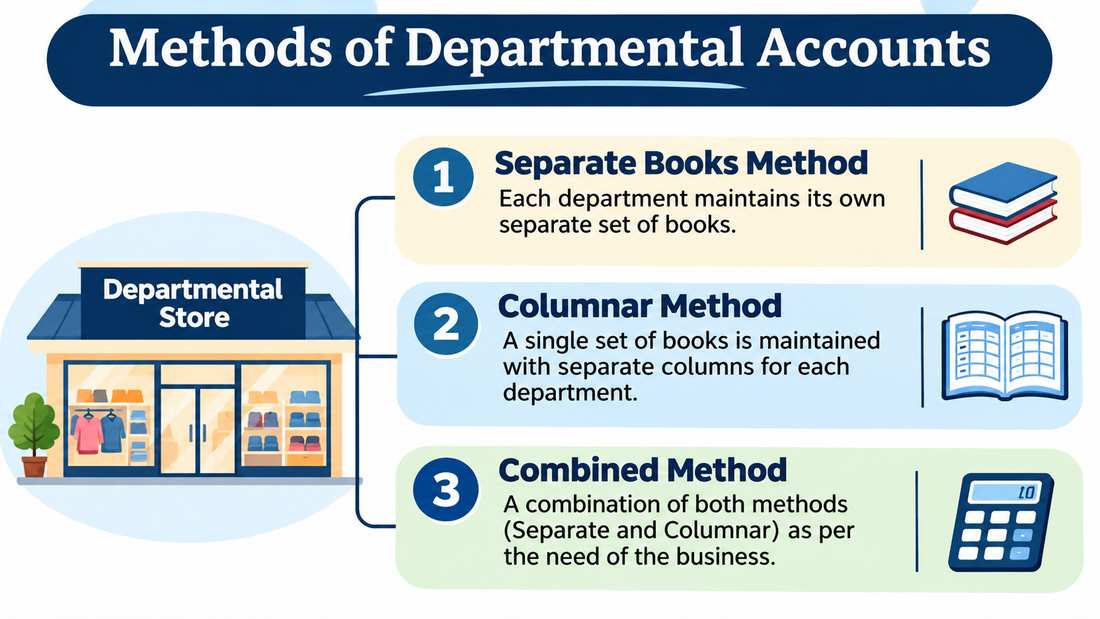
Methods of departmental accounts explain how a business with many departments actually keeps its records. We already know that a big store or supermarket has separate sections for clothes, groceries, footwear, electronics and other goods, and that the owner wants to know the profit or loss of each section separately.
But a practical question remains. How should the accounts be kept so that the result of every department can be found easily and correctly? For more solved B.Com questions, visit GNDU Papers.
Question: What are the Methods of Departmental Accounts?
There are two main methods used for this purpose. In this answer, we will discuss both methods of departmental accounts in detail, compare them, see how the final Departmental Trading and Profit and Loss Account is prepared, and understand how transfers between departments are recorded.
Meaning of Departmental Accounts in Brief
Departmental accounts are accounts prepared separately for each department of a business, so that the profit or loss of every department can be found and compared. All departments belong to the same owner, but each one is treated as a separate unit for accounting purposes.
To understand why businesses keep these accounts and what benefits they get, you can read our detailed answer to the question: Give the meaning of Departmental Accounting. Explain the objectives and advantages of Departmental Accounts.
Methods of Departmental Accounts
Broadly, departmental accounts can be kept by either of the following two methods:
- Separate or independent books for each department
- Columnar books for all departments together
Let us understand each method one by one.
Method 1: Separate Books for Each Department
Under this method, every department keeps its own complete set of books, just as if it were an independent business. Each department has its own purchase book, sales book, returns books, cash book and ledger.
At the end of the year, a separate Trading and Profit and Loss Account is prepared for each department from its own books. The head office or the main accounts department then combines the results of all departments to find the overall profit or loss of the business.
This method is suitable for very large businesses where departments are big, located on different floors or even in different buildings, and have a large number of transactions every day.
Merits of the Separate Books Method
- It gives very detailed and accurate information about each department.
- Each department can be managed and checked independently.
- Errors and frauds in one department can be found easily, because its records are kept apart.
- Departmental managers can be held fully responsible for their own records and results.
Demerits of the Separate Books Method
- It is costly, because more books, more staff and more time are needed.
- There is a lot of duplication of work.
- Combining the results of all departments at the end of the year takes extra effort.
- It is not practical for small and medium-sized businesses.
Method 2: Columnar Books
Under this method, the business keeps only one set of books for all departments, but each subsidiary book has a separate column for every department.
The purchase book, sales book, purchase returns book, sales returns book and sometimes the cash book are ruled with as many amount columns as there are departments, plus a total column.
Whenever a transaction takes place, its amount is written in the column of the department to which it belongs. At the end of each month, every column is totalled separately. These monthly totals are then posted to the departmental accounts in the ledger.
Example: Suppose a store has two departments, Clothing and Footwear. A customer named Ramesh buys clothes worth ₹5,000 and shoes worth ₹2,000 on credit. In the columnar sales book, this single entry will be recorded as follows:
- Date: 5 March
- Name: Ramesh
- Clothing column: ₹5,000
- Footwear column: ₹2,000
- Total column: ₹7,000
Ramesh’s personal account is debited with the total of ₹7,000. At the end of the month, the Clothing column total is credited to the Clothing Sales Account and the Footwear column total is credited to the Footwear Sales Account.
In this way, the sales of each department are collected separately without keeping separate books. The same method is used in the columnar purchase book and the returns books.
Merits of the Columnar Books Method
- It is simple and easy to understand.
- It is economical, because only one set of books is kept.
- It saves time and avoids duplication of work.
- The results of all departments can be seen side by side, which makes comparison easy.
- It is suitable for most small and medium-sized businesses.
Demerits of the Columnar Books Method
- If the number of departments is very large, the books become too wide and difficult to handle.
- A mistake in writing an amount in the wrong column can give wrong results for two departments at once.
- It gives less detailed information than separate books.
Difference Between the Two Methods of Departmental Accounts
1. Number of Books
Separate books method: Each department keeps its own complete set of books.
Columnar books method: One common set of books is kept with separate columns for each department.
2. Cost
Separate books method: It is costly because more staff and books are needed.
Columnar books method: It is economical and cheaper to maintain.
3. Suitability
Separate books method: It suits very large businesses with big departments.
Columnar books method: It suits small and medium-sized businesses.
4. Detail of Information
Separate books method: It gives very detailed information about each department.
Columnar books method: It gives summarised information, which is usually enough for most needs.
5. Comparison of Results
Separate books method: Results have to be brought together before they can be compared.
Columnar books method: Results appear side by side, so comparison is quick and easy.
6. Workload
Separate books method: There is more work and duplication.
Columnar books method: There is less work and no duplication.
Which of the Methods of Departmental Accounts Should a Business Choose?
The choice depends on the size of the business and the number of departments. A very large business with big, busy departments that work almost independently may prefer separate books.
Most businesses, however, choose the columnar method because it is simple, cheap and gives all the information needed for comparing departments. In practice, the columnar method is far more common.
Preparation of the Departmental Trading and Profit and Loss Account
Whichever method is followed, the final aim is the same: to prepare a Departmental Trading and Profit and Loss Account. This account is prepared in columnar form, with one column for each department and a total column.
In the Trading section, the opening stock, purchases, direct expenses, sales and closing stock of each department are shown in its own column to find its gross profit.
In the Profit and Loss section, the indirect expenses of each department are deducted to find its net profit. Common expenses such as rent, lighting, advertising and the manager’s salary are first divided among the departments on a fair basis.
The bases used for this division are explained in our separate answer to the question: Define Departmental Accounting. What are the bases upon which the joint expenses are allocated to different departments?
Simple Illustration
A business has two departments, X and Y. The following figures are given for the year:
- Opening stock: X ₹20,000, Y ₹15,000
- Purchases: X ₹80,000, Y ₹60,000
- Sales: X ₹1,50,000, Y ₹1,00,000
- Closing stock: X ₹30,000, Y ₹25,000
Gross profit of Department X:
Sales 1,50,000 + Closing stock 30,000 − Opening stock 20,000 − Purchases 80,000 = ₹80,000
Gross profit of Department Y:
Sales 1,00,000 + Closing stock 25,000 − Opening stock 15,000 − Purchases 60,000 = ₹50,000
Total gross profit of the business = ₹1,30,000
After deducting each department’s share of indirect expenses from these figures, the net profit of each department is found.
Inter-Departmental Transfers
At times, one department provides goods or services to another department of the same business. For example, a bakery department may supply cakes to the restaurant department of the same store.
Such transfers must be recorded properly. Otherwise, the supplying department will show less stock, and the receiving department will show goods it did not pay for.
The supplying department is credited and the receiving department is debited with the value of the goods transferred. Businesses commonly decide the transfer value by any of the following methods:
- At cost price: The goods are transferred at the price they actually cost. No profit is added, so no adjustment is needed later.
- At selling price or cost plus a profit: The supplying department adds a profit margin. If some of these goods remain unsold with the receiving department at the end of the year, that closing stock includes a profit that has not yet been earned by the business as a whole. This unrealised profit must be removed by creating a stock reserve.
Example: Department A moves its goods to Department B, charging 25% over the cost price. At the end of the year, Department B still holds goods worth ₹10,000 received from Department A.
Unrealised profit = 10,000 × 25/125 = ₹2,000
This ₹2,000 is deducted as a stock reserve when finding the true combined profit of the business.
Conclusion on Methods of Departmental Accounts
To conclude, there are two main methods of departmental accounts. In the first, each department keeps a separate and complete set of books. In the second, one common set of books is kept with a separate column for each department.
The separate books method gives detailed information but is costly, so it suits very large businesses. The columnar method is simple, economical and convenient, which is why most businesses prefer it.
Whichever method is used, the final result is a Departmental Trading and Profit and Loss Account that shows the gross and net profit of each department, after common expenses have been fairly shared and inter-departmental transfers have been properly adjusted.
Accounting practices for such records in India follow the guidance of the Institute of Chartered Accountants of India (ICAI). A clear understanding of these methods of departmental accounts helps students solve exam questions and also shows how real businesses keep track of every section. For more important questions and previous year papers of B.Com, check the GNDU Papers homepage.