

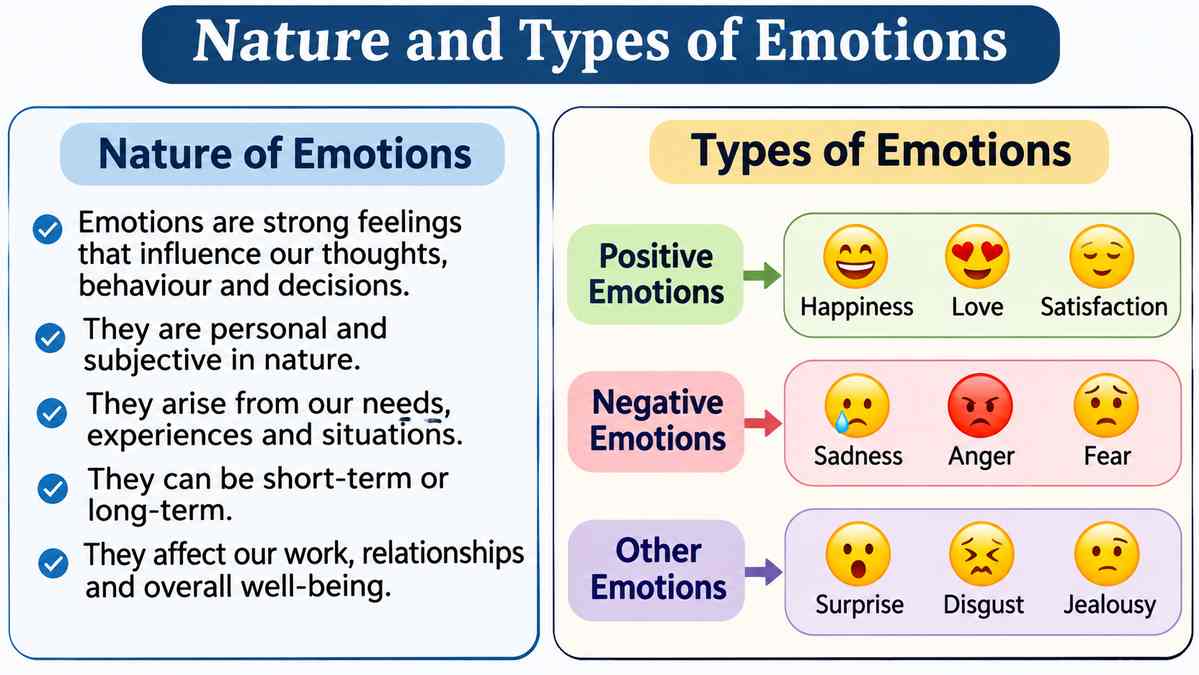
Nature and types of emotions is an important topic in organisational behaviour. Emotions are a part of everything we do. We feel happy when we get a promotion, angry when we are treated unfairly, afraid before an important interview, and proud when our work is praised.
These feelings do not stay only in our minds. They affect how we think, how we behave and how we deal with other people. For more solved B.Com questions, visit GNDU Papers.
Question: Explain Emotions, its nature and types in detail.
In the past, management experts believed that a good workplace should be purely rational, and that emotions had no place at work. Today, this view has changed completely.
It is now accepted that emotions strongly influence employee performance, decision-making, teamwork, leadership and customer service. That is why the study of emotions has become an important part of organisational behaviour.
In this answer, we will understand the meaning of emotions and the nature and types of emotions in detail.
Meaning of Emotions
The word emotion comes from the Latin word “emovere,” which means to stir up or to move out. An emotion is a strong feeling that arises in response to a particular person, event or situation, and that brings changes in our body, our thinking and our behaviour.
In simple words, emotions are intense feelings that are directed at someone or something. For example, you may feel angry at a colleague who took credit for your work, or happy about the good news of a bonus. You can read a general overview of emotion on Wikipedia.
Some well-known definitions of emotions are:
- Stephen P. Robbins: Emotions are intense feelings that are directed at someone or something.
- Crow and Crow: An emotion is an affective experience that accompanies a general inner adjustment and mental and physiological stirred-up states in the individual, and that shows itself in his overt behaviour.
From these definitions, it is clear that an emotion is not just a feeling. It is a complete experience that involves the mind, the body and behaviour.
Emotions, Moods and Affect
In organisational behaviour, three related terms are often used together. It is useful to understand the difference.
- Affect is a broad term that covers the whole range of feelings people experience. It includes both emotions and moods.
- Emotions are intense, short-lived feelings caused by a specific event, and they are directed at someone or something. For example, feeling angry because your manager scolded you in front of others.
- Moods are feelings that are less intense than emotions, last longer, and often have no clear cause. For example, simply feeling low or cheerful for the whole day without knowing why.
An emotion can turn into a mood if it stays with us for a long time. For example, the anger from a morning argument may leave you in a bad mood for the rest of the day.
Components of Emotions
Every emotion has three main components.
1. Physiological Component
This includes the changes that take place in the body, such as a faster heartbeat, sweating, blushing, trembling or changes in breathing. When we are afraid, for example, our heart beats faster and our hands may become cold.
2. Cognitive Component
This is the thinking part of emotion. It includes how we understand and judge a situation. The same event can create different emotions in different people, depending on how each person interprets it.
3. Behavioural Component
This is the outward expression of emotion through facial expressions, tone of voice, gestures and actions. A person who is happy may smile, while an angry person may raise their voice.
Nature of Emotions
The nature of emotions can be understood through their main features, which are explained below.
1. Emotions Are Universal
Every human being experiences emotions, whatever their age, gender, culture or nationality. Babies cry and smile long before they learn to speak. Basic emotions such as happiness, sadness and fear are found in all societies.
2. Emotions Are Personal and Subjective
Although everyone has emotions, each person experiences them in their own way. The same event, such as a transfer to a new city, may make one person excited and another person worried.
3. Emotions Are Caused by a Stimulus
Emotions do not arise from nowhere. They are triggered by some event, person, object or even a thought or memory.
4. Emotions Are Short-Lived
Emotions are usually brief. Intense anger or joy fades after some time. When a feeling lasts for a long time with lower intensity, it becomes a mood.
5. Emotions Involve Physical Changes
Every emotion is accompanied by changes in the body, such as heartbeat, breathing, blood pressure and muscle tension.
6. Emotions Affect Behaviour
Emotions strongly influence what we do. A happy employee may be more helpful to customers, while a frustrated employee may be careless or rude.
7. Emotions Vary in Intensity
The same emotion can be mild or very strong. For example, annoyance is a mild form of anger, while rage is an extreme form.
8. Emotions Can Be Positive or Negative
Some emotions, such as joy and love, feel pleasant. Others, such as fear and anger, feel unpleasant. Both types play an important role in human life.
9. Emotions Are Expressed and Can Be Controlled
People express emotions through words, faces and actions. With practice and maturity, they can also learn to manage and control how they express them.
10. Emotions Are Influenced by Culture
Culture affects which emotions people show openly and how they show them. In some cultures, people express emotions freely, while in others they are expected to keep their feelings to themselves.
11. Emotions Are Contagious
Emotions can spread from one person to another. A cheerful team leader can lift the mood of the whole team, while one angry person can make everyone around them tense.
Types of Emotions
Emotions can be classified in several ways. The main types are explained below.
1. Basic or Primary Emotions
Psychologist Paul Ekman identified six basic emotions that people all over the world recognise from facial expressions. These are:
- Happiness: a feeling of joy, pleasure and satisfaction. At work, it may come from achieving a target or receiving praise.
- Sadness: a feeling of loss, disappointment or grief. It may arise when an employee is denied a promotion or loses a close colleague.
- Anger: a feeling of annoyance or hostility, usually when we feel we have been treated unfairly or blocked from reaching a goal.
- Fear: a feeling of danger or threat. Employees may feel fear about losing their job, facing a strict boss or making a mistake.
- Surprise: a brief feeling that arises from something unexpected, which can be either pleasant or unpleasant.
- Disgust: a feeling of strong dislike, for example towards dishonest or unethical behaviour.
These are called basic emotions because they are found in all cultures and appear naturally from an early age.
2. Secondary or Complex Emotions
Secondary emotions are formed by a mix of basic emotions, or they arise in response to other emotions. They depend more on learning, thinking and social situations. Examples include guilt, shame, pride, jealousy, embarrassment, hope, gratitude and love.
For example, an employee who made a mistake that hurt the team may feel guilt, which is a mix of sadness and fear of disapproval.
3. Positive and Negative Emotions
Positive emotions are pleasant feelings that make people more open, creative and cooperative. Examples include joy, pride, gratitude, hope, enthusiasm and love. At work, positive emotions improve teamwork, problem-solving and job satisfaction.
Negative emotions are unpleasant feelings that can lower performance if they are not managed well. Examples include anger, fear, sadness, anxiety, jealousy and frustration.
However, negative emotions are not always harmful. Fear can make us careful, and anger can push us to correct an injustice.
4. Felt Emotions and Displayed Emotions
This classification is especially important in organisations.
Felt emotions are the actual emotions a person experiences inside.
Displayed emotions are the emotions that the organisation expects employees to show while doing their job. For example, airline cabin crew and hotel staff are expected to stay cheerful and polite even when they feel tired or irritated. A funeral director is expected to show sadness and sympathy.
When there is a gap between what an employee feels and what they must display, it is called emotional dissonance. Over time, this can cause stress and burnout.
5. Emotional Labour
Closely linked to felt and displayed emotions is the idea of emotional labour. This means the effort an employee makes to show the emotions the organisation wants during interactions with others. It is very common in service jobs such as customer care, nursing, teaching, hospitality and sales.
Emotional labour can be of two kinds:
- Surface acting: hiding one’s real feelings and showing the required emotion on the outside, such as smiling at a rude customer while feeling angry inside.
- Deep acting: trying to actually change one’s inner feelings to match the required emotion, such as genuinely trying to understand a difficult customer’s problem.
6. Self-Conscious Emotions
These emotions arise when people think about themselves and how others see them. They include pride, shame, guilt and embarrassment. They develop as a person grows and learns social rules.
Importance of Emotions in the Workplace
Emotions affect almost every part of working life.
- Decision-making: Emotions influence how people judge information and make choices. A person in a good mood may be more creative, while an anxious person may avoid risks.
- Motivation: Positive emotions such as pride and enthusiasm encourage employees to work harder. You can also read our answer on Maslow and Herzberg theory of motivation.
- Leadership: Good leaders use emotions to inspire and energise their teams.
- Customer service: An employee’s emotions directly affect how customers feel about the organisation.
- Conflict and teamwork: Uncontrolled anger or jealousy can create conflict, while positive emotions build trust and cooperation.
- Health and well-being: Long-term negative emotions can lead to stress, absenteeism and burnout.
Emotional Intelligence
Since emotions are so important, the ability to manage them has become a valuable skill. This ability is called emotional intelligence. The idea was made popular by Daniel Goleman.
It includes understanding one’s own emotions, managing them well, motivating oneself, understanding the emotions of others, and handling relationships effectively. Employees and managers with high emotional intelligence usually work better in teams and handle stress more successfully.
Conclusion on Nature and Types of Emotions
To conclude, emotions are intense feelings directed at someone or something. They involve changes in the body, the mind and behaviour.
When we study the nature and types of emotions, we find that emotions are universal yet personal, short-lived, caused by a stimulus, varying in intensity, influenced by culture and even contagious. They can be classified as basic and secondary, positive and negative, felt and displayed, and self-conscious.
In organisations, emotions shape decision-making, motivation, leadership, customer service and teamwork. A workplace that understands and manages emotions wisely, through emotional intelligence and proper support for employees, creates happier people and better results. For more important questions and previous year papers of B.Com, check the GNDU Papers homepage.