

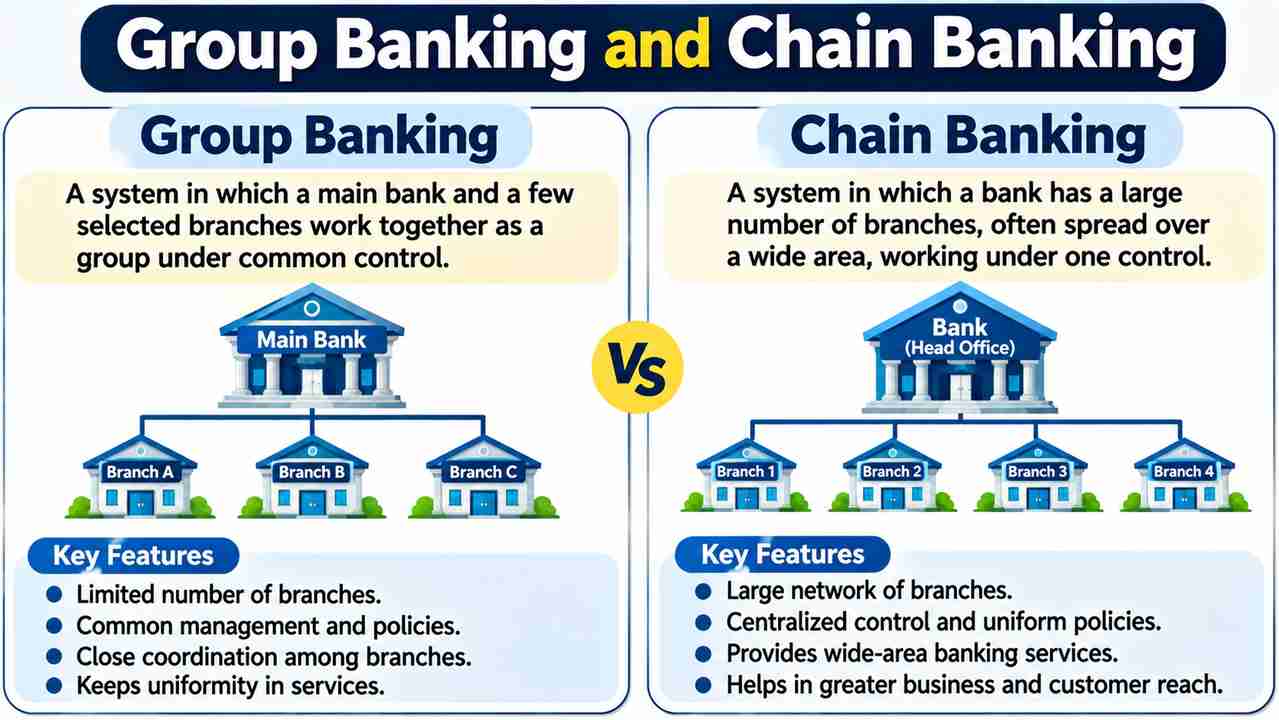
Group banking and chain banking are two special forms of bank organisation that developed mainly in the United States. Banks can be organised in different ways. In earlier answers, we learned about unit banking, where a bank works from a single office, and branch banking, where one bank works through many branches.
In this answer, we will understand the meaning, features, merits, demerits and differences of group banking and chain banking in simple language. For more solved B.Com questions, visit GNDU Papers.
Question: Explain Group Banking and Chain Banking.
Introduction to Group Banking and Chain Banking
Both systems grew because unit banks were small and weak, and in many American states the law did not allow banks to open branches freely.
So bankers found other ways to bring several banks under common control. Group banking and chain banking were the two most important of these ways.
Meaning of Group Banking
Group banking is a system in which two or more independent banks are controlled by a holding company. The holding company is a separate corporation that buys a majority of the shares of different banks. Because it owns most of their shares, it can control their policies and management.
The important point is that each bank in the group keeps its own name, its own board of directors and its own separate legal identity. The banks are not merged into one. They continue to work as separate banks, but their main policies are guided by the holding company.
In simple words, group banking means several banks working under the common control of a holding company, while each bank remains a separate unit. You can read more about the concept of a bank holding company on Wikipedia.
The holding company may itself be a bank, or it may be a purely financial company formed only to hold shares of other banks.
Example: Suppose a holding company called ABC Financial Corporation buys 60% of the shares of Bank P, Bank Q and Bank R. These three banks will still work under their own names and have their own boards. However, since ABC Corporation owns the majority of their shares, it can appoint directors and guide their major decisions. This is group banking.
Main Features of Group Banking
-
- There is a holding company at the top, which controls the group.
-
- The holding company owns a controlling share in each member bank.
-
- Each bank keeps its separate name, identity and board of directors.
-
- Member banks may be unit banks or may have their own branches.
-
- The main policies of all banks are coordinated by the holding company.
Merits of Group Banking
-
- Benefits of large-scale operation: Banks in the group can share expert staff, research, advertising and modern technology, which reduces costs.
-
- Local management continues: Since each bank keeps its own board, local knowledge and personal contact with customers are not lost.
-
- Greater financial strength: The holding company can support a weak bank in the group with funds during difficult times.
-
- Spread of risk: The risk is spread over many banks working in different areas, so the failure of one area does not ruin the whole group.
-
- Better and more specialised services: The group can offer a wider range of services to customers, such as investment advice, trust services and international banking.
-
- Escapes legal restrictions on branches: Where branch banking was not allowed, group banking gave the benefits of a large banking network.
Demerits of Group Banking
-
- Concentration of economic power: A few holding companies may control a large part of the banking system, which can lead to monopoly.
-
- Risk of misuse of funds: The holding company may use the funds of member banks for its own benefit or for risky investments.
-
- Conflict of interest: The interests of the holding company and those of the member banks may not always match.
-
- Loss of independence: Although the banks are legally separate, in practice they have to follow the policies of the holding company.
-
- Weakness spreads: If the holding company faces a crisis, all the banks in the group may suffer.
Meaning of Chain Banking
Chain banking is a system in which two or more independent banks are controlled by the same individual or group of individuals, without a holding company.
This control is usually achieved by owning shares in each bank or by having the same persons sit on the boards of directors of all the banks. This arrangement is called interlocking directorates.
Just like in group banking, each bank in the chain keeps its separate name, identity and management. However, there is no formal holding company at the top. The link between the banks is personal. It depends on the same people controlling all of them.
In simple words, chain banking means a number of separate banks connected by common ownership or common directors, without any holding company.
Example: Suppose Mr. Sharma and his family own a large number of shares in Bank X, Bank Y and Bank Z, and they are directors in all three banks. These banks work separately, but their policies are controlled by the same family. This is chain banking.
Main Features of Chain Banking
-
- Several separate banks are controlled by the same person or group of persons.
-
- There is no holding company.
-
- Control comes through ownership of shares or interlocking directorates.
-
- Each bank keeps its separate name, identity and legal existence.
-
- The banks in the chain are usually located in nearby areas.
Merits of Chain Banking
-
- Advantages of large-scale operation: The banks in the chain can coordinate their work and share facilities, which helps reduce costs.
-
- Local character remains: Each bank continues to serve its local area, keeping close contact with local customers.
-
- Mutual help: In times of need, one bank in the chain can help another with funds.
-
- Better coordination: Since the same persons control all the banks, policies can be coordinated easily and decisions can be taken quickly.
-
- Way around branch restrictions: Like group banking, chain banking gives some benefits of branch banking where opening branches is not allowed.
Demerits of Chain Banking
-
- Depends on individuals: Since control rests with a few persons, the whole chain may suffer if they take wrong decisions or face personal financial trouble.
-
- Lack of stability: There is no formal structure, so the chain may break if the controlling persons sell their shares or leave the boards.
-
- Misuse of power: The controlling persons may use the funds of the banks for their own personal business or for risky dealings.
-
- Concentration of control: Like group banking, it can lead to too much economic power in a few hands.
-
- Difficult to regulate: Because the control is informal and personal, it is harder for authorities to supervise chain banking.
Difference Between Group Banking and Chain Banking
The main differences between group banking and chain banking are explained below.
1. Basis of Control
Group Banking: The banks are controlled by a holding company.
Chain Banking: The banks are controlled by an individual or a group of individuals.
2. Holding Company
Group Banking: A holding company is present at the top.
Chain Banking: There is no holding company.
3. Method of Control
Group Banking: Control is exercised by owning the majority of shares through the holding company.
Chain Banking: Control is exercised through personal share ownership or interlocking directorates.
4. Nature of Structure
Group Banking: It has a formal and well-organised structure.
Chain Banking: It has an informal and personal structure.
5. Stability
Group Banking: It is more stable, because the holding company is a permanent legal body.
Chain Banking: It is less stable, because it depends on the life, wealth and decisions of a few individuals.
6. Size and Area
Group Banking: It is generally larger and may cover a wide area.
Chain Banking: It is generally smaller and usually covers nearby areas.
7. Regulation
Group Banking: It is easier to regulate, as the holding company can be supervised directly.
Chain Banking: It is harder to regulate, as the control is personal and not always visible.
Conclusion on Group Banking and Chain Banking
To conclude, group banking and chain banking are two forms of bank organisation in which several independent banks come under common control while keeping their separate identities.
In group banking, the control lies with a holding company that owns the majority of shares in the member banks. In chain banking, the control lies with one person or a group of persons through share ownership or common directors, without any holding company.
Group banking and chain banking developed mainly in the United States to overcome the weaknesses of unit banking and the legal limits on branch banking. They offer benefits like economies of scale, mutual support and local management.
At the same time, they carry risks such as concentration of power, misuse of funds and conflicts of interest. Of the two, group banking is more organised and stable, while chain banking depends heavily on the honesty and ability of the persons who control it.
For more important questions and previous year papers of B.Com, check the GNDU Papers homepage.