

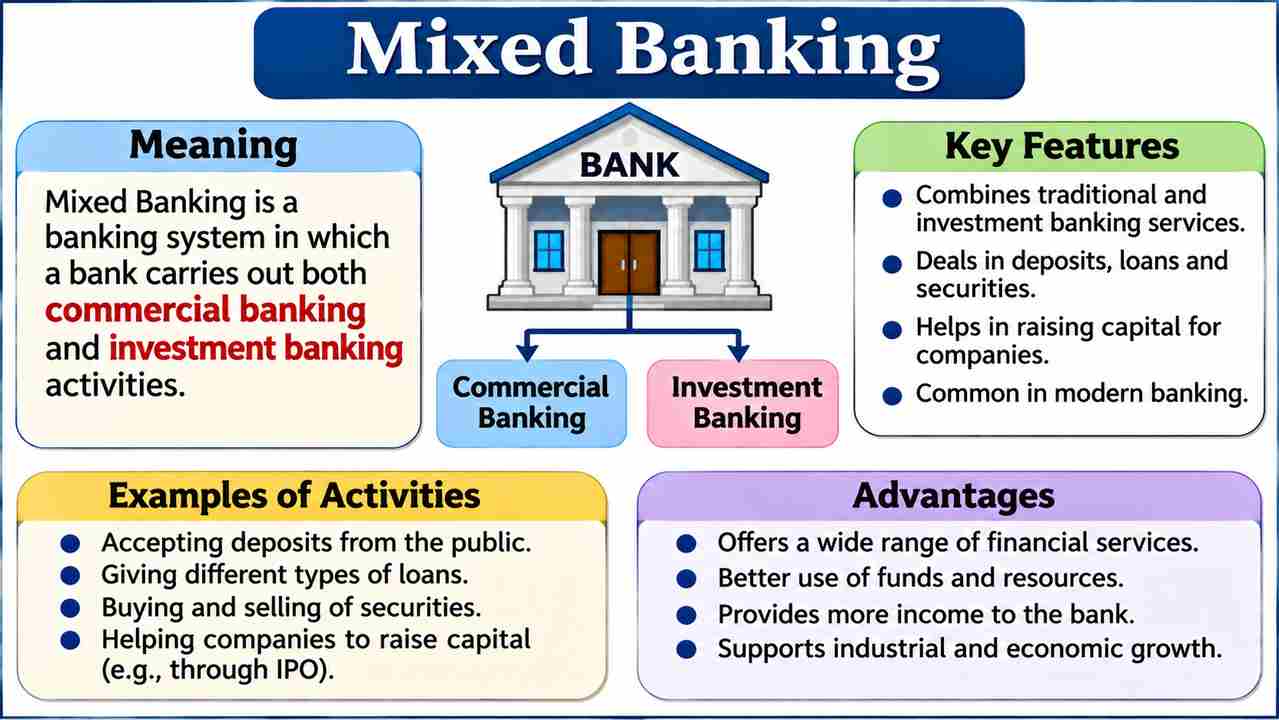
Mixed banking is an important topic in the study of banking, because it shows how a bank can play two roles at the same time. Usually, we think of a bank as a place that accepts deposits from the public and gives short-term loans to traders and businessmen.
But some banks go a step further. Along with ordinary banking, they also provide long-term finance to industries. Such a system is known as mixed banking. For more solved B.Com questions, visit GNDU Papers.
Question: What is Mixed Banking? Discuss its merits and demerits.
In this answer, we will understand the meaning of mixed banking, its main features, and its merits and demerits in simple language.
Meaning of Mixed Banking
Mixed banking is a system in which a bank does both commercial banking and industrial (investment) banking at the same time.
In other words, the bank not only provides short-term loans for working capital but also gives long-term loans to industries for buying land, buildings, machinery and other fixed assets.
Under mixed banking, a bank may also buy shares and debentures of companies, underwrite new issues of securities, and help in setting up new industrial units. So the bank mixes the work of a commercial bank with the work of an industrial bank. That is why it is called mixed banking.
The best-known example of mixed banking is Germany, where banks have long been closely involved with industries. They not only lend money to companies but also hold their shares and have representatives on their boards of directors.
This is one reason why German industry grew so quickly in the nineteenth and twentieth centuries.
In India, banks traditionally followed the British model and mainly gave short-term loans. Over time, however, Indian banks also started giving term loans to industries, investing in company securities and offering many financial services.
Today, the idea of mixed banking has taken the wider form of universal banking, under which a bank offers almost all financial services under one roof.
Main Features of Mixed Banking
-
- The bank performs both commercial banking and industrial banking functions.
-
- It provides short-term as well as long-term finance.
-
- It may invest in the shares and debentures of companies.
-
- It may underwrite new issues of shares and debentures.
-
- It often has a close relationship with the industries it finances.
-
- It uses part of its deposits for long-term industrial finance.
Merits of Mixed Banking
Mixed banking offers many advantages to industries, banks and the economy as a whole. The main merits are explained below.
1. Helps in Industrial Development
The greatest merit of mixed banking is that it promotes the growth of industries. New and existing industries need long-term funds to buy machinery, build factories and expand their business.
Mixed banks provide this finance easily, which helps the country develop industrially.
2. Better Use of Bank Funds
Banks often have large deposits, especially fixed deposits, that remain with them for a long time.
Under mixed banking, these funds can be used for long-term lending instead of lying idle. This leads to better and more profitable use of the bank’s resources.
3. Higher Profits for the Bank
Long-term loans and investments in shares and debentures usually earn a higher return than short-term loans. So mixed banking increases the income and profits of the bank.
4. Expert Guidance to Industries
Since mixed banks are closely connected with industries, they can give expert advice on financial planning, expansion, technology and management. This helps industries run more efficiently.
5. Complete Finance from One Place
A business can get both its short-term and long-term financial needs met by the same bank.
This saves time, effort and cost, because the business does not have to approach different institutions for different needs.
6. Better Knowledge of the Borrower
When a bank provides both short-term and long-term loans to a company, it gets complete knowledge of the company’s financial position.
This helps the bank take better lending decisions and reduces the chances of bad debts.
7. Helps in Capital Formation
Mixed banking channels the savings of the public into productive industrial investment. This increases capital formation in the country, which is essential for economic growth.
8. Useful for Developing Countries
In developing countries, the capital market is often weak, and industries find it hard to raise long-term funds.
Mixed banking fills this gap and acts as an important source of industrial finance.
Demerits of Mixed Banking
Although mixed banking has many advantages, it also has some serious drawbacks. The main demerits are as follows.
1. Problem of Liquidity
The biggest weakness of mixed banking is the problem of liquidity. Banks mainly collect short-term deposits from the public, which can be withdrawn at any time.
If these deposits are locked up in long-term loans, the bank may not have enough cash to pay depositors when they demand it. This can create a crisis.
2. Risk of Bank Failure
Industrial loans and investments in shares carry a high level of risk. If the industries suffer losses or the share market falls, the bank may lose a large amount of money.
In extreme cases, this can even lead to the failure of the bank.
3. Loss of Public Confidence
If a bank faces difficulty in repaying its depositors because its money is tied up in long-term loans, people may lose faith in it.
A single bank’s trouble can sometimes spread fear among depositors of other banks too.
4. Effect of Trade Cycles
Industries are badly affected during periods of depression. When industries suffer, the banks that have given them long-term finance also suffer.
So mixed banks are more exposed to the ups and downs of the economy.
5. Concentration of Economic Power
Since mixed banks hold shares in companies and often have representatives on their boards, a few big banks may gain control over many industries.
This can lead to concentration of economic power and the growth of monopolies.
6. Neglect of Commercial Banking
A mixed bank may become so involved in industrial finance that it neglects its basic duty of serving traders, small businesses and ordinary customers with short-term credit.
7. Need for Special Skills
Industrial financing requires technical knowledge and expert judgement to study projects and assess risk.
Ordinary bank staff may not have these skills, which can lead to wrong lending decisions.
8. Conflict of Interest
When a bank is both a lender to a company and a shareholder in it, conflicts of interest may arise.
The bank may continue to support a weak company to protect its investment, even when doing so is not in the interest of its depositors.
How to Reduce the Demerits of Mixed Banking
The risks of mixed banking can be reduced by following a few precautions. Banks should use only their long-term funds, such as capital, reserves and fixed deposits, for industrial finance.
They should spread their loans and investments across many industries to reduce risk. They should also employ trained experts to study industrial projects properly.
Strong supervision by the central bank, which in India is the Reserve Bank of India, is also necessary to make sure that banks do not take excessive risks.
Conclusion on Mixed Banking
To conclude, mixed banking is a system in which a bank combines the work of a commercial bank with the work of an industrial bank. It provides both short-term and long-term finance and may also invest in and underwrite the securities of companies.
Mixed banking has many merits. It helps industrial development, makes better use of bank funds, increases bank profits, provides expert guidance and supports capital formation.
At the same time, it suffers from problems of liquidity, high risk, possible loss of public confidence and concentration of economic power.
Therefore, mixed banking can be very useful, especially in developing countries like India, but only if it is practised carefully, with proper safeguards and strict supervision. When managed well, it can become a strong pillar of both the banking system and industrial growth.
For more important questions and previous year papers of B.Com, check the GNDU Papers homepage.