

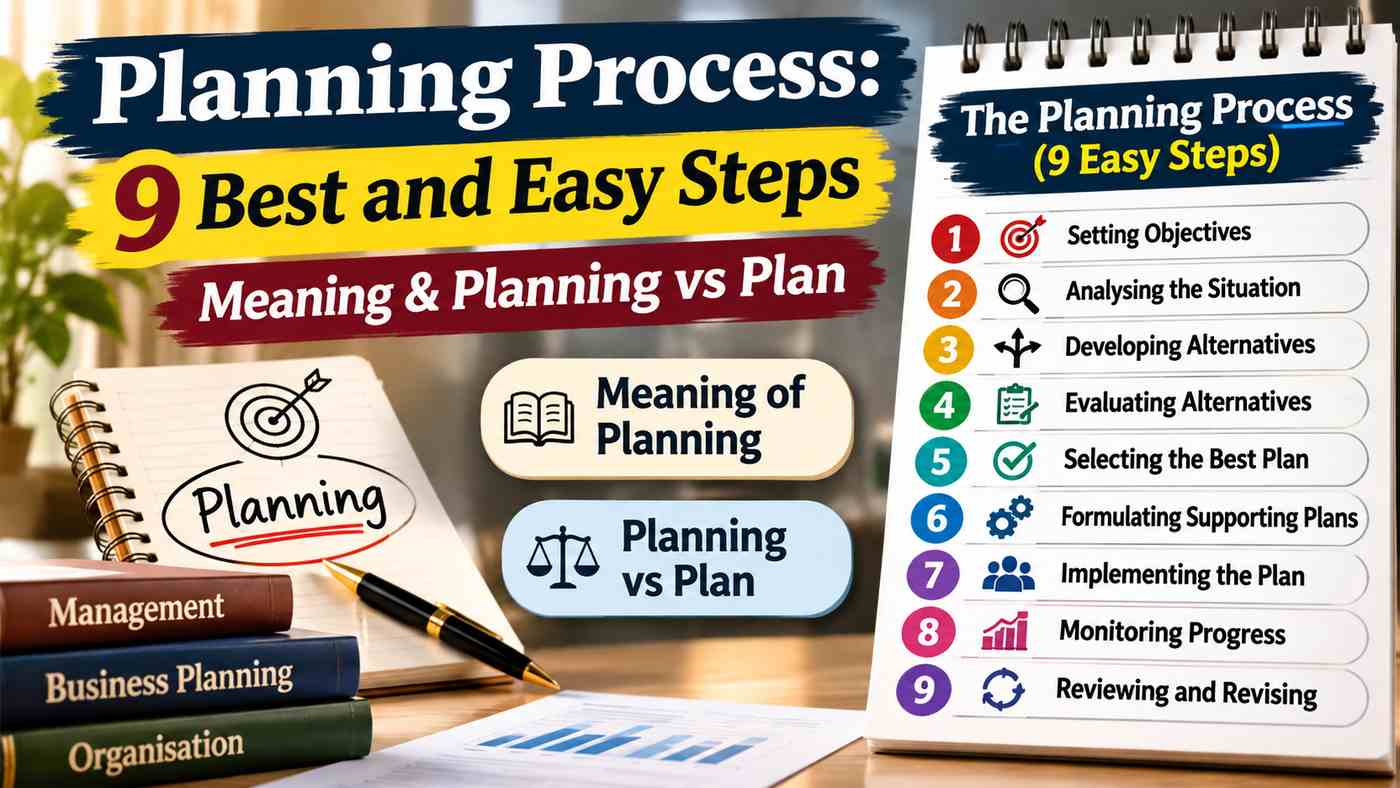
The planning process is the first and most important function of management. Every person plans something in daily life. A student plans for exams, a housewife plans the monthly budget, and a businessman plans how to increase sales.
In this answer, we will understand what planning is, the difference between planning and plan, and all the steps of the planning process in simple language. This question is very important for B.Com and M.Com exams. You can find more such solved papers on GNDU Papers.
Question: What is planning? What is the difference between planning and plan? Describe the planning process.
Introduction to Planning Process
Every organisation, whether small or large, needs planning to run smoothly. All other functions of management, such as organising, staffing, directing and controlling, are built on it.
Without a proper planning process, an organisation is like a ship without a captain. It moves, but nobody knows where it will end up.
What is Planning? Meaning of Planning Process
In simple words, planning means deciding in advance what is to be done, how it is to be done, when it is to be done, and who is going to do it. It is thinking before doing.
Planning acts as a road that connects our present position with the goals we hope to reach tomorrow. The planning process involves setting objectives and then choosing the best course of action to achieve them.
Since the future is uncertain, planning tries to look ahead, predict possible situations, and prepare for them in advance. You can read more about the general idea of planning on Wikipedia.
Several management experts have defined planning in their own words:
-
- Koontz and O’Donnell: Planning is deciding in advance what to do, how to do it, when to do it and who is to do it. Planning bridges the gap from where we are to where we want to go.
-
- Louis A. Allen: Planning is the determination of a course of action to achieve a desired result.
-
- George R. Terry: Planning is the selecting and relating of facts and the making and using of assumptions regarding the future in the visualisation and formulation of proposed activities believed necessary to achieve desired results.
From these definitions, it is clear that the planning process is a mental activity. It needs thinking, imagination, foresight and good judgement.
Main Features of Planning Process
-
- Planning is goal-oriented. Every plan is made to achieve some objective. Without a goal, planning has no meaning.
-
- Planning is the primary function of management. It comes before all other functions. The plan provides the base on which organising, staffing, directing and controlling are performed.
-
- Planning is pervasive. It is needed at all levels of management — top, middle and lower. Top managers make long-term plans, while lower-level managers make day-to-day plans.
-
- Planning is continuous. The planning process never stops. When one plan is completed, a new one is made.
-
- Planning is futuristic. It always looks ahead. It deals with what will happen tomorrow, next month or next year.
-
- Planning involves decision-making. Planning means choosing the best option from many alternatives. So, decision-making is at the heart of the planning process.
-
- Planning is a mental exercise. It requires thinking, logic and imagination rather than guesswork.
-
- Planning is flexible. A good plan can be changed when the situation changes.
Importance of Planning Process
The planning process gives direction to the organisation. It reduces uncertainty because managers think about future problems in advance.
It avoids wastage of time, money and resources. It helps in coordination, because every department knows what it has to do.
It also encourages new ideas and makes controlling easier, because actual performance can be compared with planned targets.
Difference Between Planning and Plan
Many students think that “planning” and “plan” mean the same thing. They are closely connected, but they are not the same. Planning is the process, while a plan is the result of that process.
Let us understand it with an easy example. Take the example of a family that has made up its mind to travel for a holiday.
They sit together, discuss places, check their budget, compare train and flight options, and finally decide to go to Shimla for five days in December by train.
The whole act of discussing, comparing and deciding is planning. The final decision — “Shimla, five days, December, by train” — is the plan.
The main differences can be explained as follows:
| Basis | Planning | Plan |
|---|---|---|
| Meaning | Planning involves thinking about the future and choosing both the task and the method in advance. | A plan is what we finally get at the end of this process. |
| Nature | It is a mental activity or a process. | It is a written or clear statement of a decided course of action. |
| Continuity | Planning is a continuous process that keeps going. | A plan is fixed for a certain period or purpose. |
| Order | Planning comes first. | A plan comes after planning is complete. |
| Form | Planning is abstract; it happens in the minds of managers. | A plan is concrete; it can be written, seen and communicated. |
| Scope | Planning is broad and includes forecasting, analysing and choosing. | A plan is narrow and specific, showing only the chosen course of action. |
| Examples | Studying the market, forecasting demand and comparing options. | Budgets, policies, procedures, programmes, rules and schedules. |
In simple terms, planning is what we do, and the plan is what we end up with. Planning is the thinking process, and the plan is the final shape that thinking takes.
A plan cannot exist without the planning process, and planning is incomplete until it produces a plan.
Steps of the Planning Process
Planning is not done in a single step. The planning process is a systematic series of steps. Following these steps in order helps managers make sound, practical plans.
1. Being Aware of Opportunities
The planning process begins with an awareness of opportunities. Managers should look at the market, competition, customer needs, technology and government policies.
They should also understand the strengths and weaknesses of their own organisation. For example, a company may notice that people are buying more eco-friendly products and see an opportunity to launch one.
2. Setting Objectives
Once opportunities are identified, the next step is to set clear objectives. Objectives tell us what the organisation wants to achieve. They should be specific, measurable and achievable.
For example, “to increase sales by 15% in the next year” is a clear objective, while “to increase sales” is too vague. Objectives are set first for the whole organisation, and then for each department.
3. Developing Planning Premises
Planning premises are the assumptions about the future on which plans are based. Since nobody knows the future for certain, managers have to make some assumptions about demand, prices, government policy, interest rates and competition.
Premises can be internal (like company resources) or external (like economic conditions). Correct premises lead to good plans, and wrong premises can make the entire planning process fail.
4. Identifying Alternative Courses of Action
There is usually more than one way to achieve an objective. In this step, managers list all the possible ways or alternatives.
For example, to increase sales, a company may cut prices, increase advertising, improve product quality, open new outlets or start selling online.
5. Evaluating the Alternatives
Each alternative is then studied carefully. Managers look at cost, risk, time required, resources needed and expected profit.
Some options may be cheap but slow, while others may be fast but costly. Tools like cost-benefit analysis, statistics and past experience are used at this stage of the planning process.
6. Selecting the Best Alternative
After evaluation, the most suitable alternative is selected. This is the real point of decision-making. The best option gives the maximum benefit with the minimum cost and risk.
Sometimes managers may choose a combination of two or more alternatives. At this stage, the plan actually takes shape.
7. Formulating Derivative (Supporting) Plans
The main plan is usually supported by smaller plans called derivative plans. These are detailed plans for different departments.
For example, if the main plan is to launch a new product, derivative plans will be needed for production, purchase of raw materials, hiring of staff, advertising and finance.
8. Implementing the Plan
A plan is useless if it remains only on paper. In this step, the plan is put into action. Managers communicate the plan to employees, assign duties, arrange resources and start the work.
9. Follow-up and Review
The last step is follow-up. Managers keep checking whether the plan is being carried out properly. If there is any gap between planned and actual performance, corrective action is taken.
This step makes the planning process continuous, because the review of one plan often becomes the starting point of the next. Planning is closely linked with other functions of management, especially controlling.
Limitations of Planning Process
While planning is very useful, it also has some limitations. It is time-consuming and costly. It is based on assumptions about the future, which may turn out to be wrong.
Too much planning can make an organisation rigid and slow to react to sudden changes. However, these limitations can be reduced by keeping plans flexible and reviewing them regularly.
Conclusion: Planning Process in Short
To conclude, planning is the foundation of management. Planning and plan are closely related, but planning is the process of thinking and deciding, while a plan is the final result of that process.
The planning process moves step by step — from spotting opportunities and setting objectives, to making assumptions, evaluating alternatives, choosing the best one, making supporting plans, implementing them and reviewing the results.
That is why it is rightly said that “failing to plan is planning to fail.” For more B.Com and M.Com important questions and previous year papers, visit our GNDU Papers homepage.