

Unit banking and branch banking are the two main systems on which banks are organised. Banks play a very important role in the economy of any country. They collect savings from the public and give loans to people who need money for business, agriculture, education, housing and other purposes.
However, banks do not all work in the same way when it comes to their structure. Some banks work from only one office, while others spread their offices across many cities and villages. In this answer, we will understand the meaning, features and differences of unit banking and branch banking in simple language. For more solved B.Com questions, visit GNDU Papers.
Question: Differentiate between Unit Banking and Branch Banking.
To understand the difference between unit banking and branch banking, we first need to understand the meaning of each system.
Meaning of Unit Banking
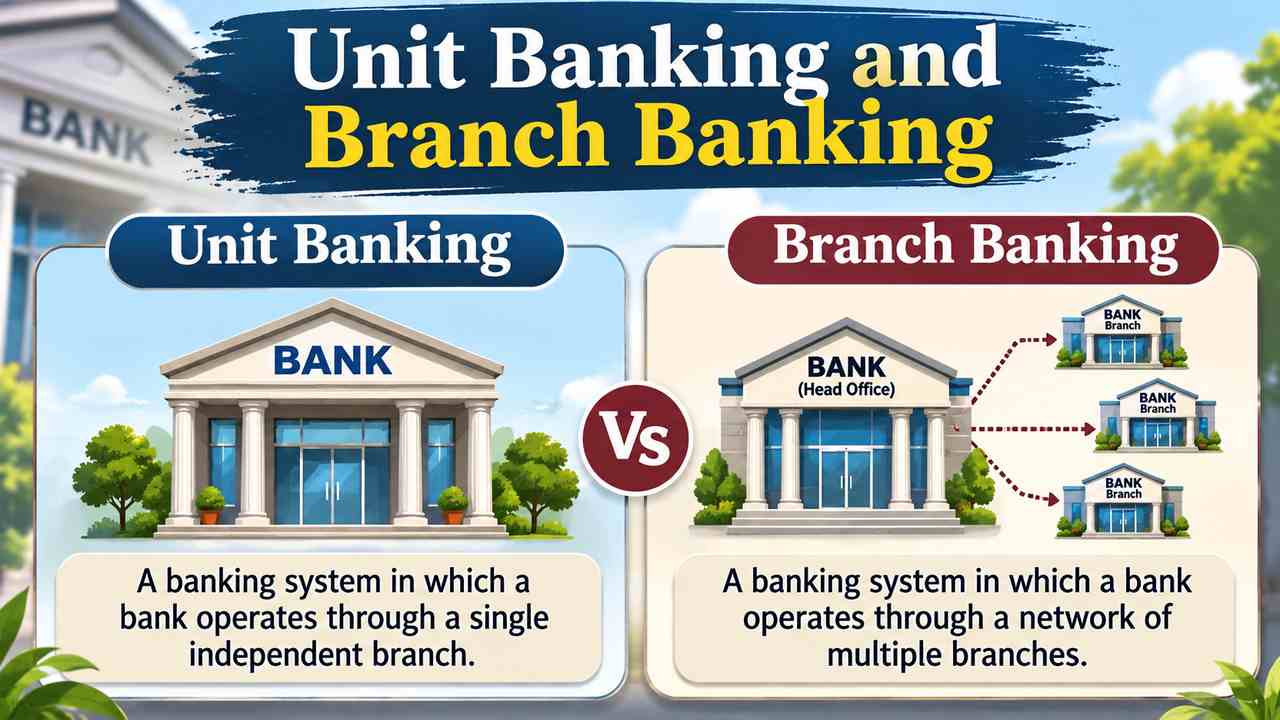
Unit banking is a system in which a bank works through a single office. It has no branches. The bank serves only the people of the local area where it is located.
Its management, operations and services all happen from that one office. Unit banking is common in the United States, where it developed historically. You can read more about the history of unit banking on Wikipedia.
Many small American banks serve only their local town or community. A unit bank may have links with other banks through the correspondent banking system, but it does not open its own branches.
Main Features of Unit Banking
- The bank works from one office only.
- Its area of operation is small and local.
- It is managed by its own board of directors, who usually live in the same area.
- It mostly uses local deposits to give loans to local people.
- It is usually small in size, with limited capital and resources.
Meaning of Branch Banking
When a bank operates through a wide network of offices spread across different regions, the system is known as branch banking. The bank has a head office, usually in a big city, and a number of branches in other cities, towns and villages.
All the branches work under the control and supervision of the head office. Branch banking is the main system in India, the United Kingdom, Canada and many other countries.
For example, the State Bank of India, Punjab National Bank and HDFC Bank have thousands of branches across the country, all controlled from their head offices. In India, all these banks work under the guidance of the Reserve Bank of India.
Main Features of Branch Banking
- The bank has one head office and many branches.
- Its area of operation is wide, sometimes covering the whole country or even foreign countries.
- The head office makes the main policies, and the branches follow them.
- Funds can be moved from one branch to another as needed.
- It is usually large in size, with huge capital and resources.
Difference Between Unit Banking and Branch Banking
The main differences between unit banking and branch banking are explained below.
1. Meaning
Unit Banking: The bank works from a single office and has no branches.
Branch Banking: The bank works through a head office and a network of branches in different places.
2. Size of the Bank
Unit Banking: The bank is usually small, with limited capital and a small number of customers.
Branch Banking: The bank is usually large, with huge capital and a very large number of customers.
3. Area of Operation
Unit Banking: Its work is limited to a small local area, such as one town or city.
Branch Banking: Its work covers a wide area, often the whole country and sometimes other countries too.
4. Management and Control
Unit Banking: It is managed locally by its own board of directors. Decisions are taken on the spot.
Branch Banking: It is controlled by the head office. Branch managers have to follow the rules and policies set by the head office.
5. Speed of Decision-Making
Unit Banking: Decisions are taken quickly, because the managers are local and do not need approval from anyone else.
Branch Banking: Decisions can be slow, especially on big loans, because branch managers often have to wait for approval from higher offices.
6. Knowledge of Local Needs
Unit Banking: The managers know local people and local business conditions very well, so they can serve local needs better.
Branch Banking: Branch managers are often transferred from one place to another, so they may not fully understand local needs.
7. Use of Funds
Unit Banking: Local savings are mostly used for local development. Money stays in the same area.
Branch Banking: Funds can be transferred from one area to another. Savings from villages may be used to give loans in big cities.
8. Distribution of Risk
Unit Banking: Risk is high, because all the loans and investments are in one small area. If the local economy suffers, the bank may also fail.
Branch Banking: Risk is spread over many areas and industries. A loss in one area can be balanced by profits in another, so the bank is more stable.
9. Economies of Large-Scale Operation
Unit Banking: Being small, the bank cannot enjoy the benefits of large-scale operation, such as lower costs and specialised staff.
Branch Banking: Being large, the bank enjoys economies of scale. It can hire expert staff, use modern technology and reduce its cost per customer.
10. Transfer of Money
Unit Banking: Sending money to other places is difficult and costly, because the bank has no branches elsewhere. It depends on other banks.
Branch Banking: Money can be transferred easily and cheaply from one place to another through its own branches.
11. Spread of Banking Facilities
Unit Banking: It cannot spread banking services to rural and remote areas, because it works from only one place.
Branch Banking: It helps spread banking facilities to villages and small towns by opening branches there.
12. Chances of Bank Failure
Unit Banking: There is a greater chance of failure, because the bank is small and its resources are limited.
Branch Banking: There is less chance of failure, because the bank is big, strong and well spread out.
13. Cash Reserves
Unit Banking: The bank has to keep large cash reserves, because it cannot get help from other branches in an emergency.
Branch Banking: The bank can manage with smaller cash reserves at each branch, because the head office can send cash wherever it is needed.
14. Personal Contact with Customers
Unit Banking: There is close personal contact between the bank and its customers, as both belong to the same locality.
Branch Banking: Personal contact is less, because the bank is big and its staff keep changing.
15. Monopoly and Competition
Unit Banking: There is little chance of monopoly, because many small banks compete with one another.
Branch Banking: There is a risk of monopoly, because a few big banks may control the entire banking system.
16. Implementation of Monetary Policy
Unit Banking: It is difficult for the central bank to control and guide a large number of small, independent banks.
Branch Banking: It is easier for the central bank to implement its monetary policy, because it has to deal with fewer but larger banks.
Merits and Demerits of Unit Banking and Branch Banking at a Glance
Unit banking is good for local development, quick decisions and close personal service. But it is weak, risky and unable to spread banking facilities widely.
Branch banking is strong, safe and suitable for spreading banking services across the country. It also allows easy transfer of funds and better use of resources.
On the other hand, branch banking can be slow in decision-making, may ignore local needs, and can lead to the concentration of economic power in a few hands.
Which is Better: Unit Banking and Branch Banking Compared
Both unit banking and branch banking have their own merits and demerits. Unit banking suits countries where people want local control and where the local economy is strong.
Branch banking suits developing countries like India, where banking services need to reach every corner of the country, including villages. Because it is safer and more efficient, branch banking is more popular in most parts of the world today.
Conclusion on Unit Banking and Branch Banking
To conclude, unit banking and branch banking are two different ways of organising banks. In unit banking, a bank works from a single office and serves only its local area. In branch banking, a bank works through a large network of branches under the control of a head office.
Unit banking offers quick decisions, local knowledge and personal service, but it is small and risky. Branch banking offers safety, wide coverage, easy transfer of funds and economies of scale, but it may be slow and less personal.
Given the needs of a large and growing economy like India, branch banking has proved to be the more useful and practical system. For more important questions and previous year papers of B.Com, check the GNDU Papers homepage.